

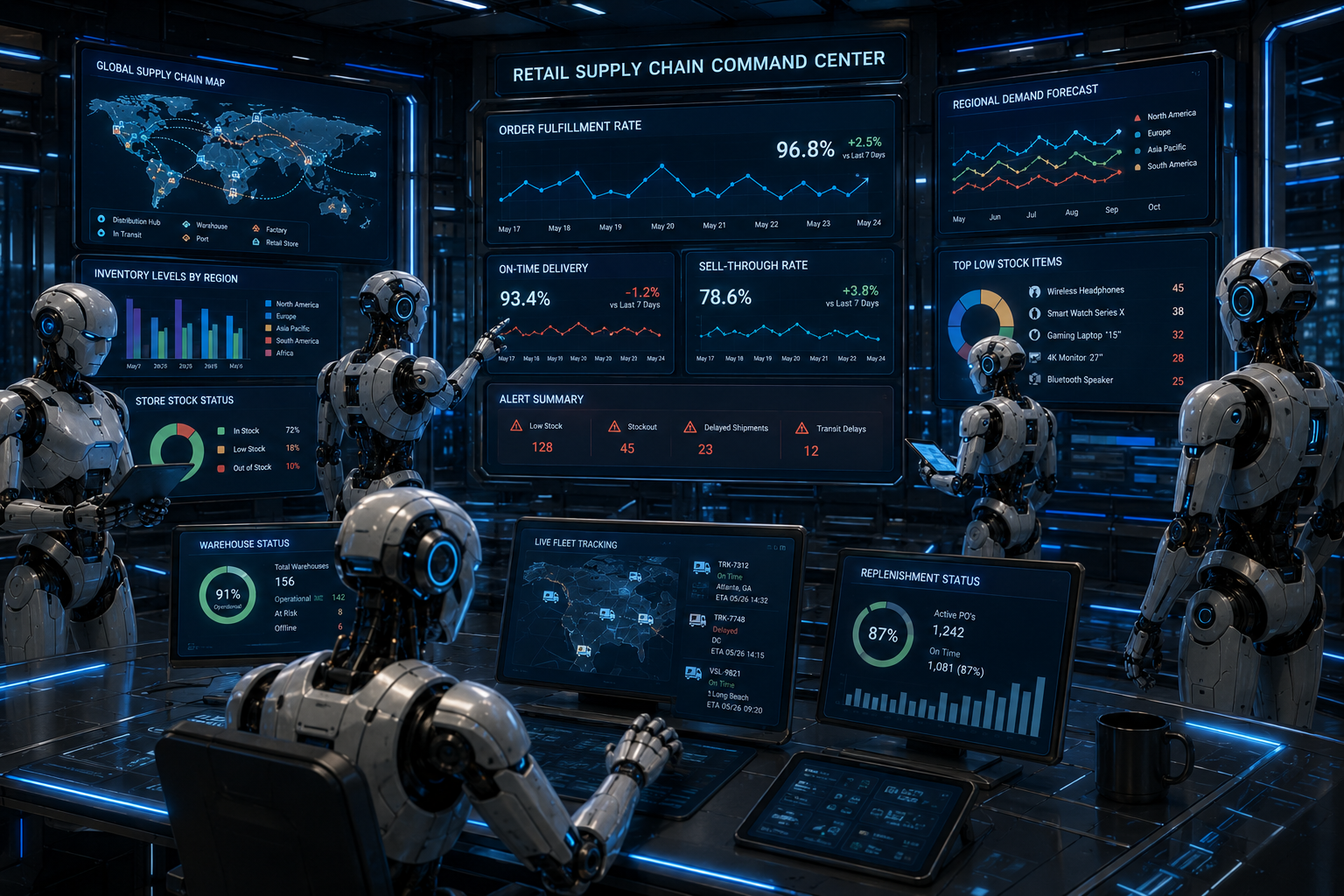
AI Agents Work at a Speed Humans Simply Cannot
Retail supply chains generate an overwhelming volume of signals every single minute — inventory movements, demand shifts, supplier delays, warehouse bottlenecks. No human team, no matter how skilled or how large, can monitor all of it continuously and act before the margin window closes. AI agents can. Unlike dashboards that wait to be checked or chatbots that wait to be asked, agents run silently in the background, watching every data stream at second and minute level, around the clock, across every store, warehouse, and supplier node simultaneously. This is not about making analysts faster. It is about operating at a speed and scale that human attention was never designed to match.
Scale Changes Everything
The reason supply chain problems compound is that the data has always outpaced the people reviewing it. Modern retail operations span hundreds of locations, thousands of SKUs, and dozens of interconnected systems, all generating signals at the same time. What makes this solvable today is not generic AI, but a purpose-built agent architecture designed specifically for supply chain operations.
Our technology and AI agents are built to handle this scale — processing live operational data continuously, covering the entire operation in real time rather than a slice of it on demand. And unlike generic approaches, our agents get smarter as your inventory moves, as your warehouses shift stock, and as your supply chain responds to real-world demand. The more your operations run, the sharper the detection and the faster the response — building an intelligence that is specific to how your business actually works.
Reliable Agents Make Automation Possible
Speed and scale only matter if the outputs can be trusted. This is where reliability becomes the deciding factor. An agent that hallucinates an inventory level or misreads a demand signal does not save money, it creates a different kind of crisis. When agents are built on verified ground truth rather than probabilistic guessing, they cross a critical threshold: they become reliable enough to not just flag problems, but to fix them. That is when automation at scale becomes real. Reliable AI agents can trigger purchase orders, reroute shipments, and rebalance inventory across locations without waiting for human sign-off at every step. For an industry running on margins below 4%, that shift from alert to autonomous action is not a feature upgrade. It is the entire point.